Chef Life Love

As many of my readers know, I’m currently in school for a BA in Creative Writing and English. I have been immensely busy, but I thought it time to update my probably long-forgotten blog with a new post. I did make the return to restaurants, but as a line cook to make school more manageable. Chef is one of those titles, though, that once you’ve earned it, it is yours to keep forever. The last restaurant I worked at before my current position was at a fine dining establishment. I don’t want to get too into what went wrong there, suffice it to say I did a lot of soul-searching during that time and that’s when I made the decision to go back to school. After a brief stint away from restaurants, I found the right balance back in the kitchen. However, while I was at that restaurant (whose name I will not mention) I had a fair amount of creative freedom. Indeed, from my first sous chef role and onward I’ve been blessed with a wonderful amount of creative freedom, and some of the best food local farms have to offer. I thought it appropriate to share some of the dishes I played with at the restaurant.

                I began in the summer, after Shine closed. For the record, our closing was not a “covid casualty,” but an opportunity that couldn’t have been ignored; I think I can say for all of us, that we walked away with our heads held high. But back to food.
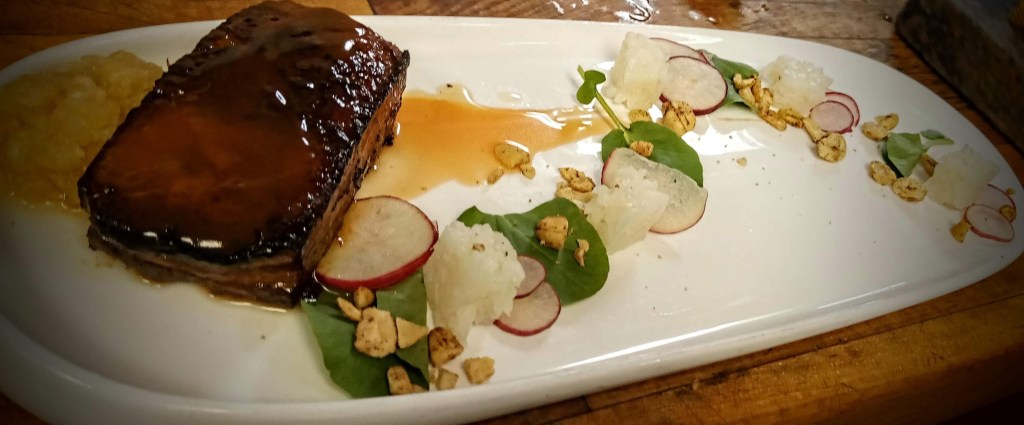
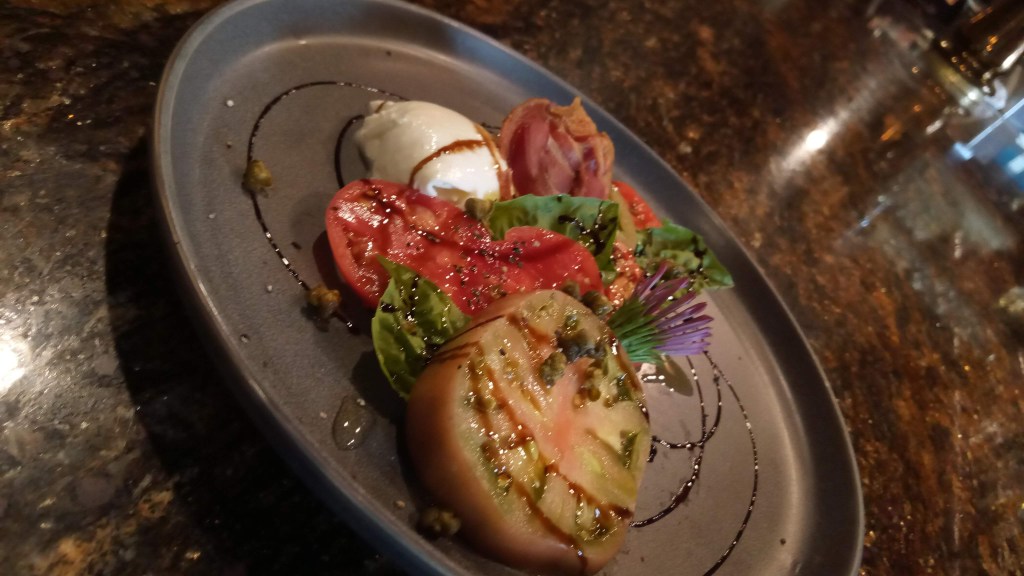
The restaurant I went to had an enormous garden filled with myriad fruits and vegetables. The very first thing I got on the menu at that restaurant was an app: ponzu glazed pork belly, with an orange gastrique (fruit sauce containing alcohol or vinegar), sesame ginger rice, pickled pineapple, Chinese five spiced cashews, nasturtium leaves, and shaved radish. Any of my readers who know me know that I feel like summer just isn’t summer without heirloom tomatoes. We served beautiful, juicy slices of homegrown heirloom tomatoes seasoned with flaked salt and cracked pepper, basil, pancetta crisp, fried capers, balsamic reduction, EVOO, and burrata, the supreme version of fresh mozzarella.
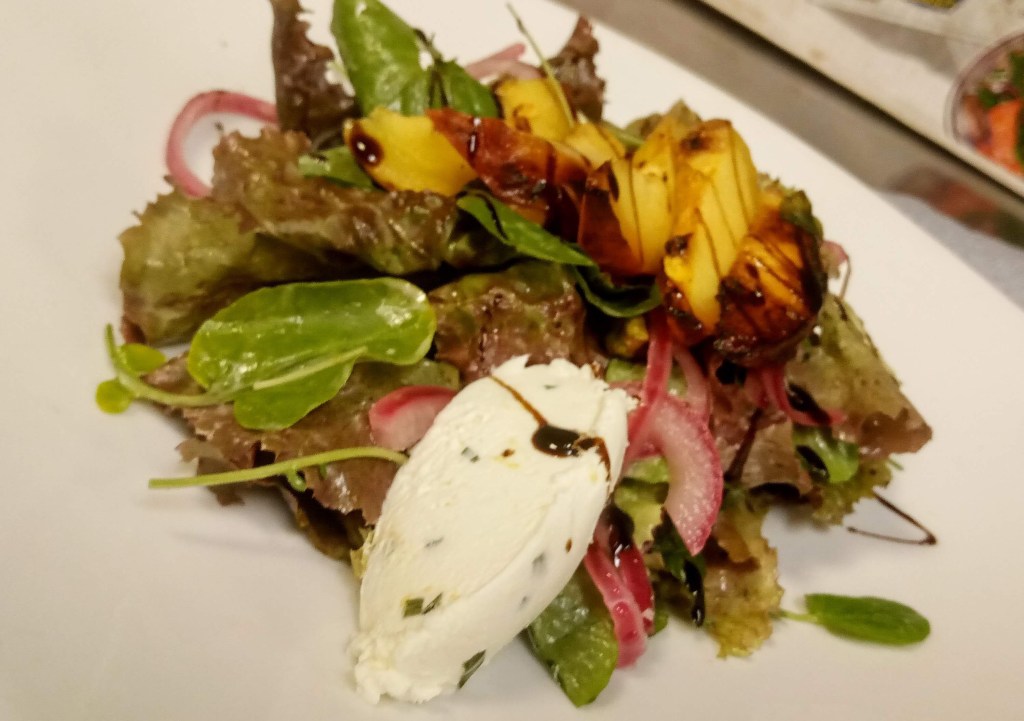
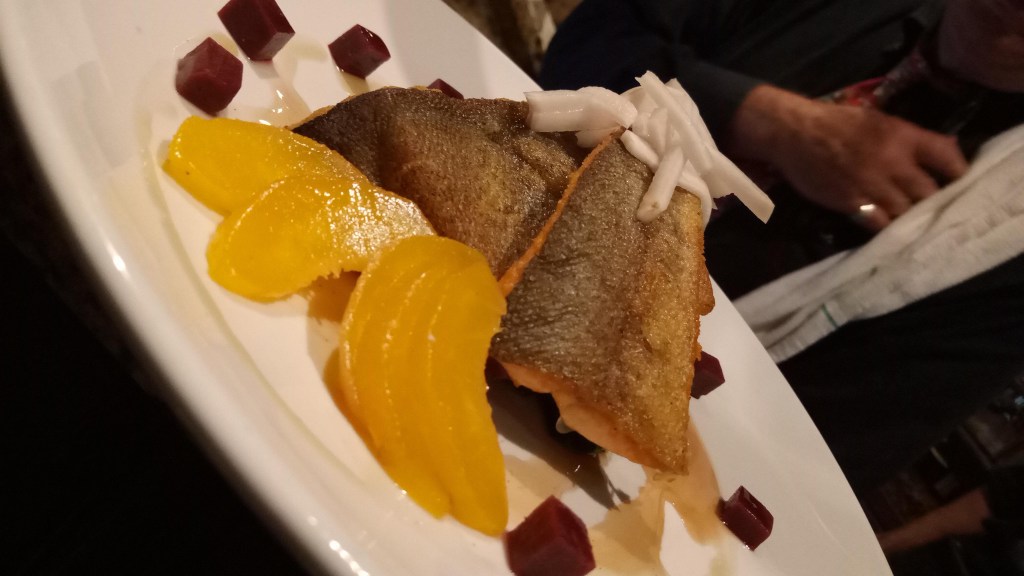
 Colorado Palisade peaches are considered the supreme peaches out here in the mountains. As such, we had to do a grilled peach salad, with a red leaf lettuce (the name escapes me) mixed with watercress, white balsamic vinaigrette, pickled red onions, herbed goat cheese, pistachios, and balsamic drizzle. Speaking of peaches, when halved, pitted, and placed in a cryovac bag overnight they become compressed, and so are a hyper-flavorful version of themselves with a pleasing denser texture. This works with any porous fruit. Blackberries, of course pair beautifully with peaches, and if you have access to agar agar, a melt-in-your-mouth fruit gel is easy to make with any juice or puree. So with the compressed peach and blackberry gels we served a seared ruby red trout, Swiss chard, a bourbon maple butter sauce, and garnished with pickled turnips.
As the weather began to cool, fall flavors came to the forefront. We poached pears in red wine and served them on a bed of spinach tossed in a cranberry tarragon vinaigrette with smoked dates, candied walnuts, we brought back the pickled red onions, and traded the goat cheese out for a creamy blue one. We did a pappardelle pasta with a mushroom ragout, roasted red peppers, sage, and pine nuts. I adore toasted pine nuts on pasta, it is highly underrated. I made some fabulous Butternut squash and herb goat cheese ravioli, with a pecan brown butter sauce; we paired some beautiful wild mushrooms and roasted brussels sprouts and garnished with shaved parm for plating the ravioli.

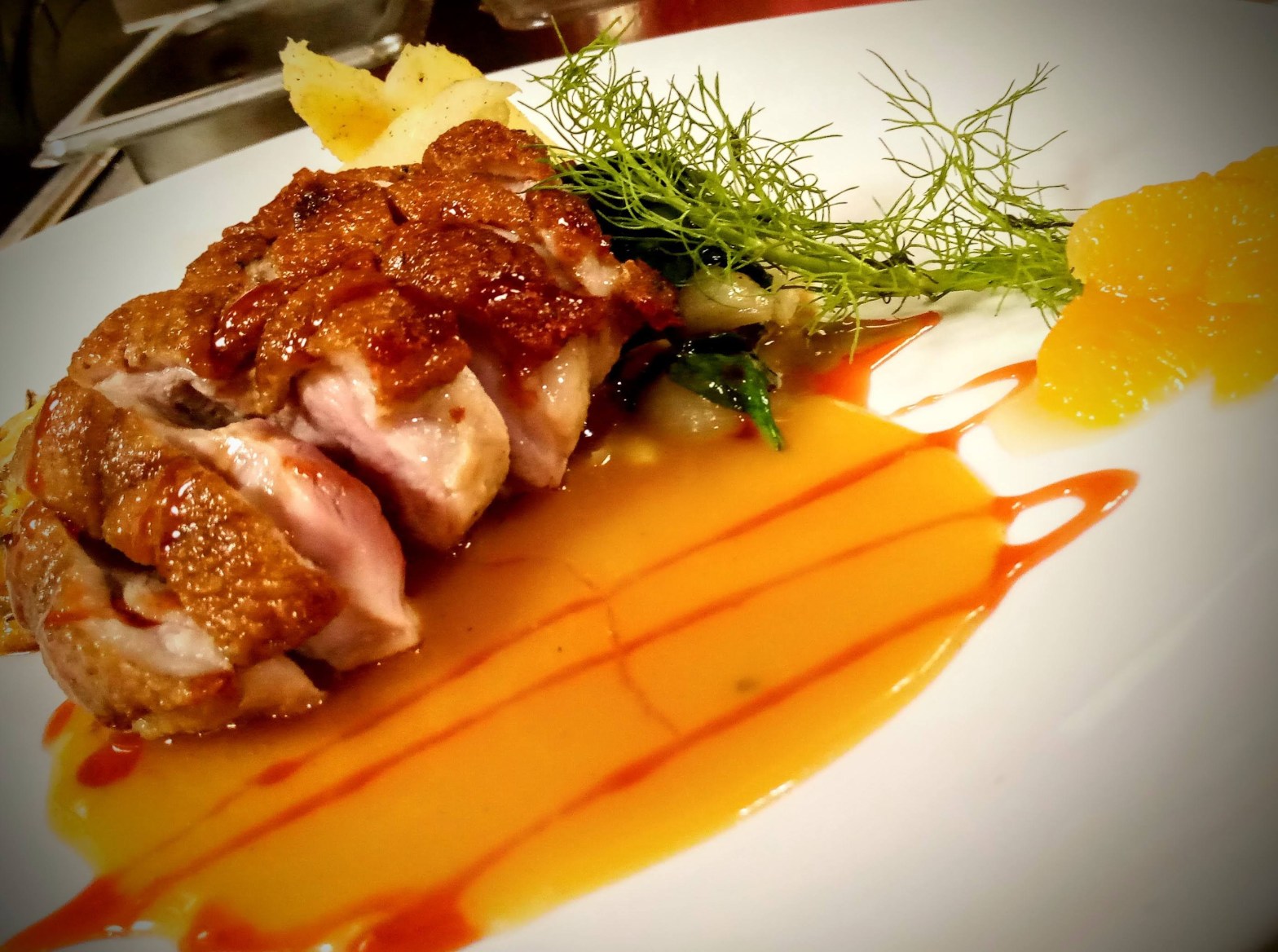
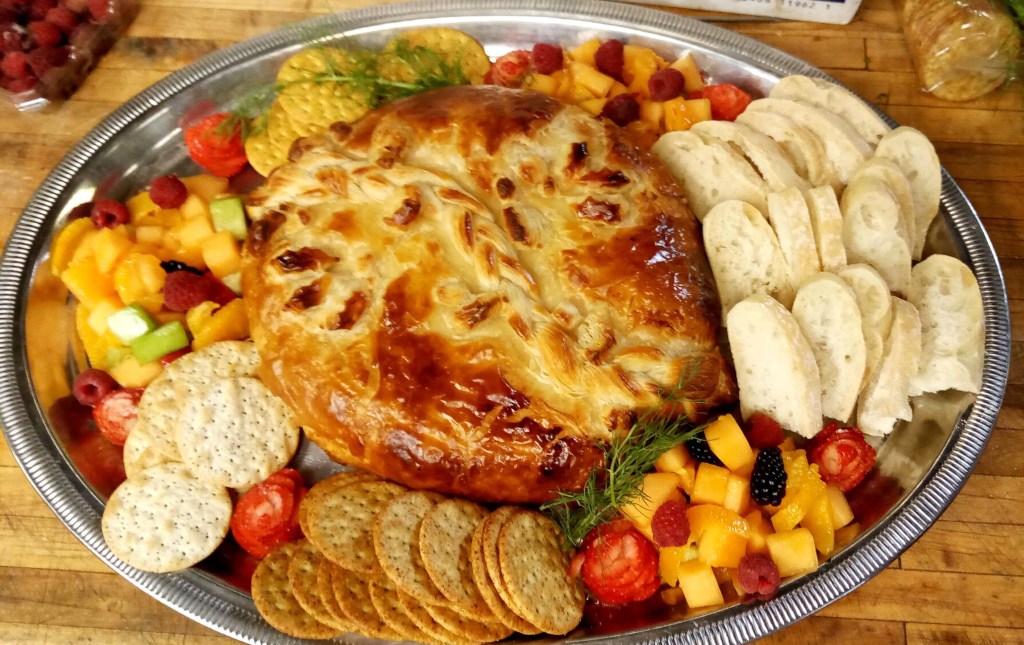
The Starks are eventually always right, winter came. I wrapped and plated a beautiful baked wheel of brie and served for a party on a platter with crackers, bread, and fruit. With the holidays around the corner, I wanted to serve my take on a French classic. Duck l’Orange is a personal favorite and I like to do a modern take on the dish. So we served a pan seared duck breast at a perfect medium rare, with an orange gastrique, and a blood orange reduction, served with a butternut squash gratin, a blend of sauteed spinach, mushrooms and pearl onions, and vanilla roasted parsnips. For a garnish I made an orange and thyme confit. For this non-traditional confit, simple syrup is poured over orange supremes (just the inner segment, no pith or the membrane that separates the segments) and fresh thyme which permeates beautifully in the confit once it’s cooled.
We ended up with way more pork loin than we needed and in an effort to get rid of it, and make the servers say a bunch of stuff in German, we did a pork schnitzel with “Rotkohl mit Apfeln” which is a braised red cabbage with apples, sauteed carrots, and buttery spätzle (a German egg noodle) which I made closer to the traditional way on a board with a pallet knife rather than through a grater or perforated hotel pan. The traditional way makes for a longer, more slender noodle which I find texturally more appealing (not to say the bigger clumps aren’t still great!). We garnished the dish with my grandma’s sweet pickles which are awesome.

Many of these dishes are easy enough to execute at home even with slight variance to make it a little easier. Wrapping brie in puff pastry and baking it isn’t difficult, and it makes for a lovely platter that will be a huge hit. Duck l’Orange is a great holiday dinner to consider for next year, though depending on the number of people, it may be easier to go with a more classic, whole bird presentation.

I’m glad to be on my current path. It has been a lot of hard work thus far, but I love that I’m building a life around writing, reading, and language. I’ll try to post articles more regularly, but I do have to prioritize. Thank you to all my readers! Have safe travels and happy holidays, my friends!
Spring Samplings

                As any Coloradoan will tell you, there is a certain buzz about springtime in the Rockies. That initial bright green of spring contrasts with the still snow-covered mountains. The heavy hungers of winter give way to desires of lighter fare. If gardeners don’t already have their sprouts started, we get them going early in spring to prepare for the glory of growing season.

                It’s cool enough where soup can still be had, though lighter soups prevail. Thoughts of onion types, and mushrooms dance in my brain. Flowers we associate as vegetables bring their signature to the party. Leafy greens and cabbages abound in spring. Fruit is still minimal, but around mid-spring strawberries and rhubarb become available.

                Seafood certainly has a season as well, and while cod and oysters are on their way out of season, Halibut, swordfish, flounder and sole along with a school of others are on their way in. Purchasing seafood seasonally can help promote responsible fishing practices.

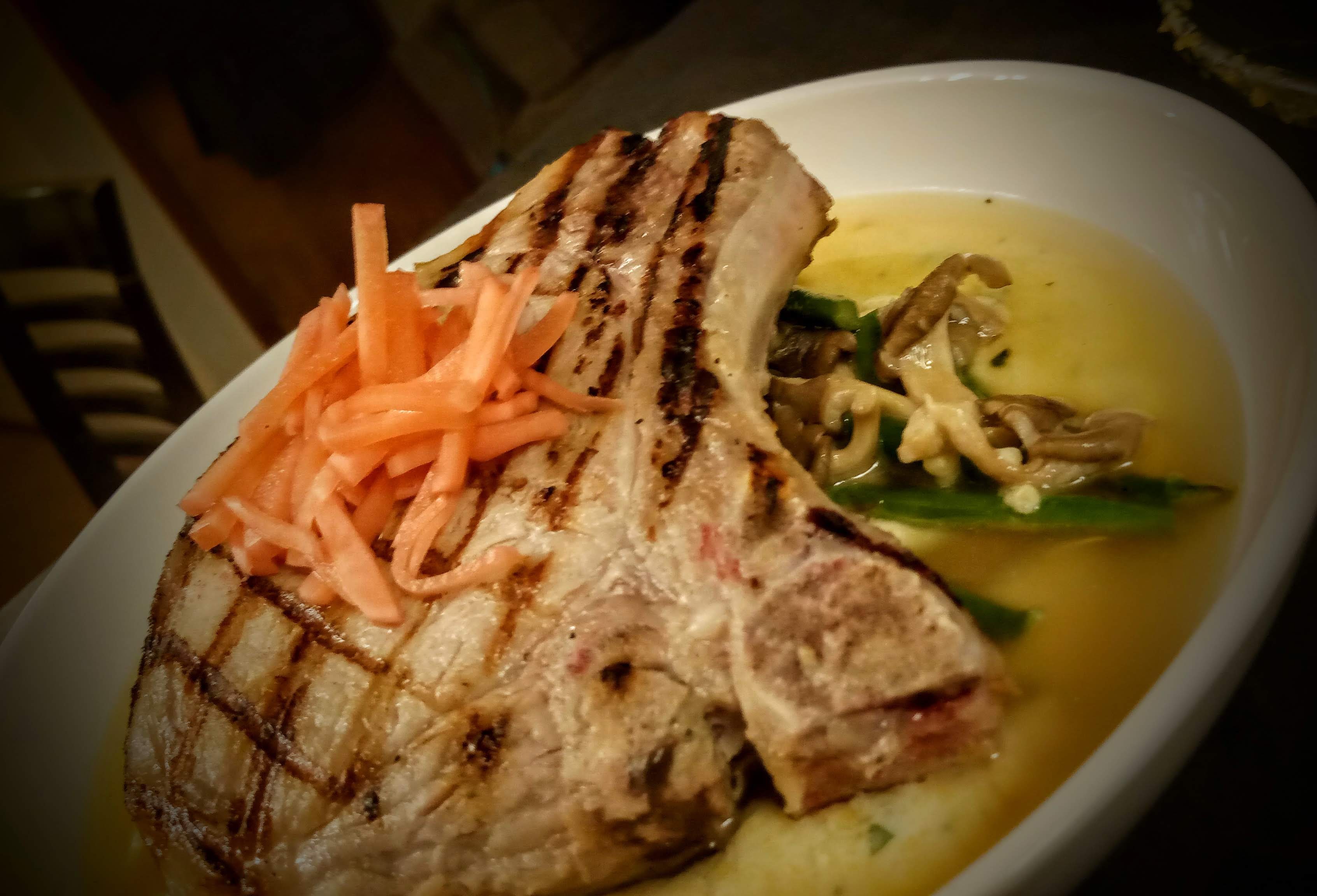
Bourbon brined Buckner Farms pork chop, with creamy polenta, sautéed asparagus and local oyster mushrooms, leek consommé, and garnished with pickled radish

                One of the first things to grow as the weather begins to warm, is mushrooms. The prized morel seems even more elusive in Colorado than in Michigan, but they can be found, particularly in recently burned areas. Morels are such a wonderful flavor, that they need little more than a sauté in a nice spoonful of butter and a pinch of salt. But Morels are not the only mushrooms to grace the Rockies! Chantrelles can be foraged, along with black oyster mushrooms. A royal mushroom of many names is also highly coveted. Sometimes called King Bolete, and other times Cèpes, but mainly known as Porcini, this big, meaty mushroom is a favorite among chefs and diners!

                Stinging Nettle is also common in spring, though it seems uncommon to see a lot of restaurants using them. They pair beautifully with lovage, a floral celery like herb. Nettles, with their spinach-y flavor but fibrous (and stingy!) texture must be cooked, and go wonderfully in soup, or as a sauce. Lovage on the other hand is very delicate, and cooking too hard will destroy its flavor.

                Onions and other members of their family are some of the first to pop up out of the ground. Unfortunately for me, Colorado is much too dry to grow the damp-loving ramp. Also called ‘wild leeks’ ramps have a lovely green leaf with a strong garlicky flavor, and a skinny pink stalk that is nice and oniony. The stalk pickles beautifully, and the leaves make a fabulous pesto. However, great leeks are grown in Colorado and their sweetness is just as enjoyable as their wild cousins. They are versatile and can be eaten raw if shaved thin, and are lovely with salads, or braised, then seared and used as side, perhaps with a piece of fish, and some fingerling potatoes.

                One of my favorite spring ingredients is undoubtedly artichokes. Botanically a flower, artichokes are a good deal of work to process, but the reward is worth the effort. Baby artichokes are nice because the choke hasn’t developed enough to be inedible yet, although they are more difficult to find in stores.

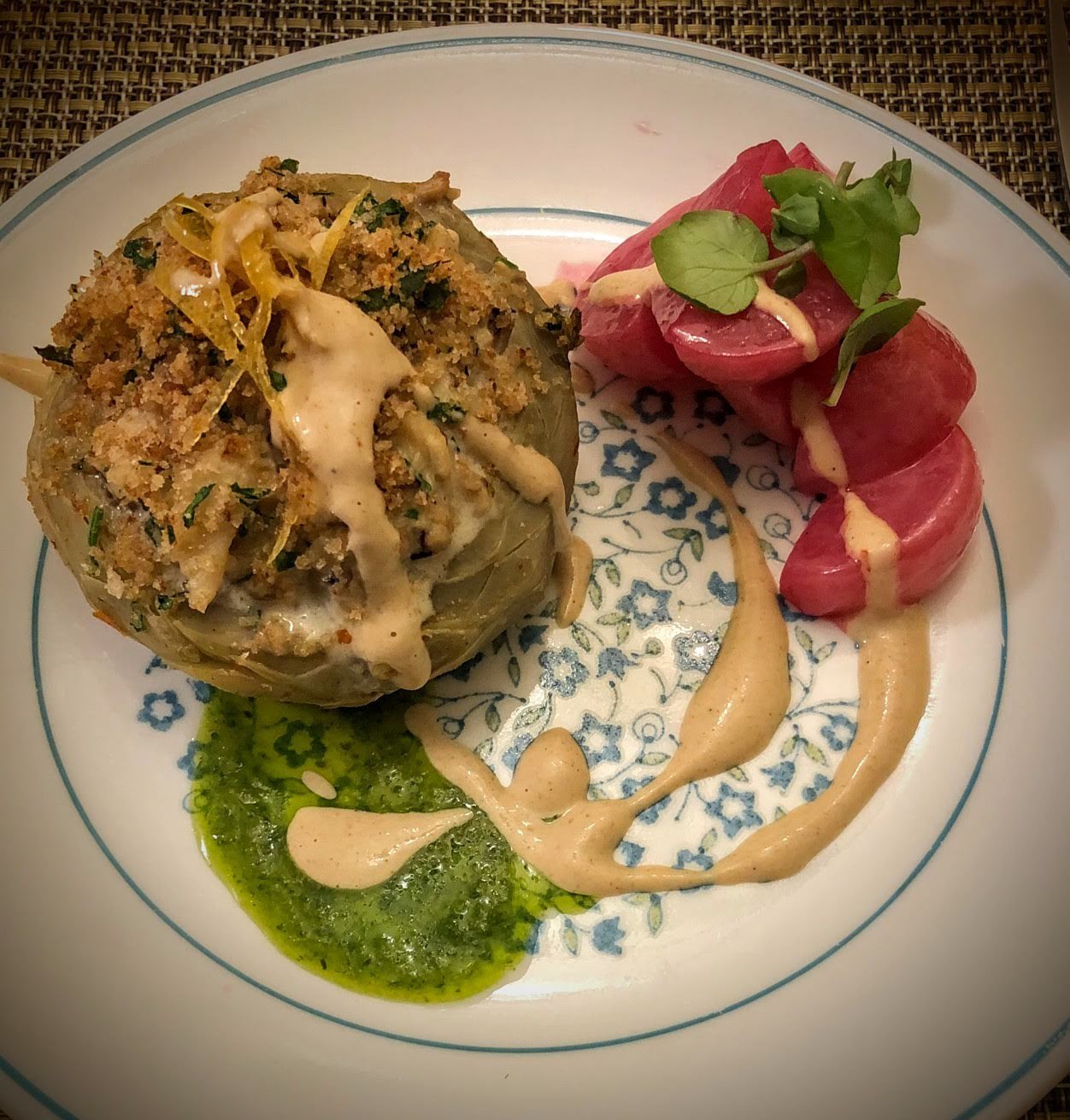
 Artichoke petals have a small amount of edible flesh which is lovely when dipped in hollandaise. They also make a nice vehicle as a sort of canape for an amuse bouche. A poached heart (with the stem removed) is wonderful stuffed with mushroom duxelles and crab, and topped with breadcrumbs. Lemon, garlic, Red pepper flakes, bell peppers and parmesan or pecorino are all very standard pairings with artichokes.

It is virtually impossible to think of spring vegetables and not think of asparagus. Arguably, it could be considered the signature vegetable of the season. It is one of the first to grow, and (depending of course on where you are and the terroir of the region) stays great until the extreme heat of summer turns the plants woody. Spread a little herbed ricotta and parm blend (only good ricotta!) on a slice of prosciutto and wrap around raw or blanched asparagus with a little balsamic reduction for a simple and elegant hors d’oeuvres. They go beautifully with morels and ramps in all sorts of pasta dishes as well.

Little fruit is available, particularly in early spring, but Strawberries and Rhubarb are the first to grow. Of course, we all know the classic pie, but there is so much more to both of those fabulous ingredients. Any number of salads can be devised with them, and I find the peppery bite of arugula is nice with the sweetness of spring strawberries. Strawberries also make lovely sauces for use in savory or sweet applications.

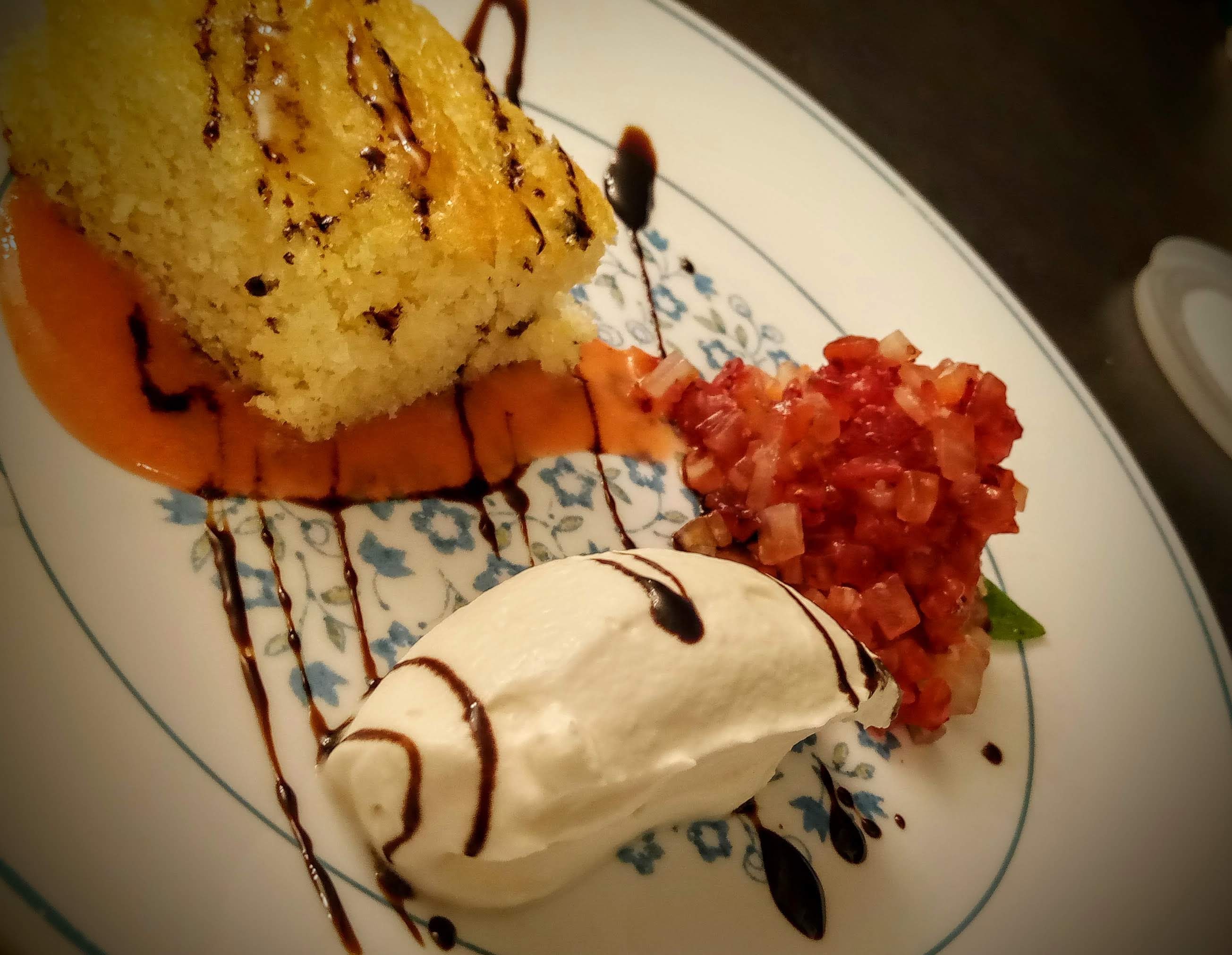
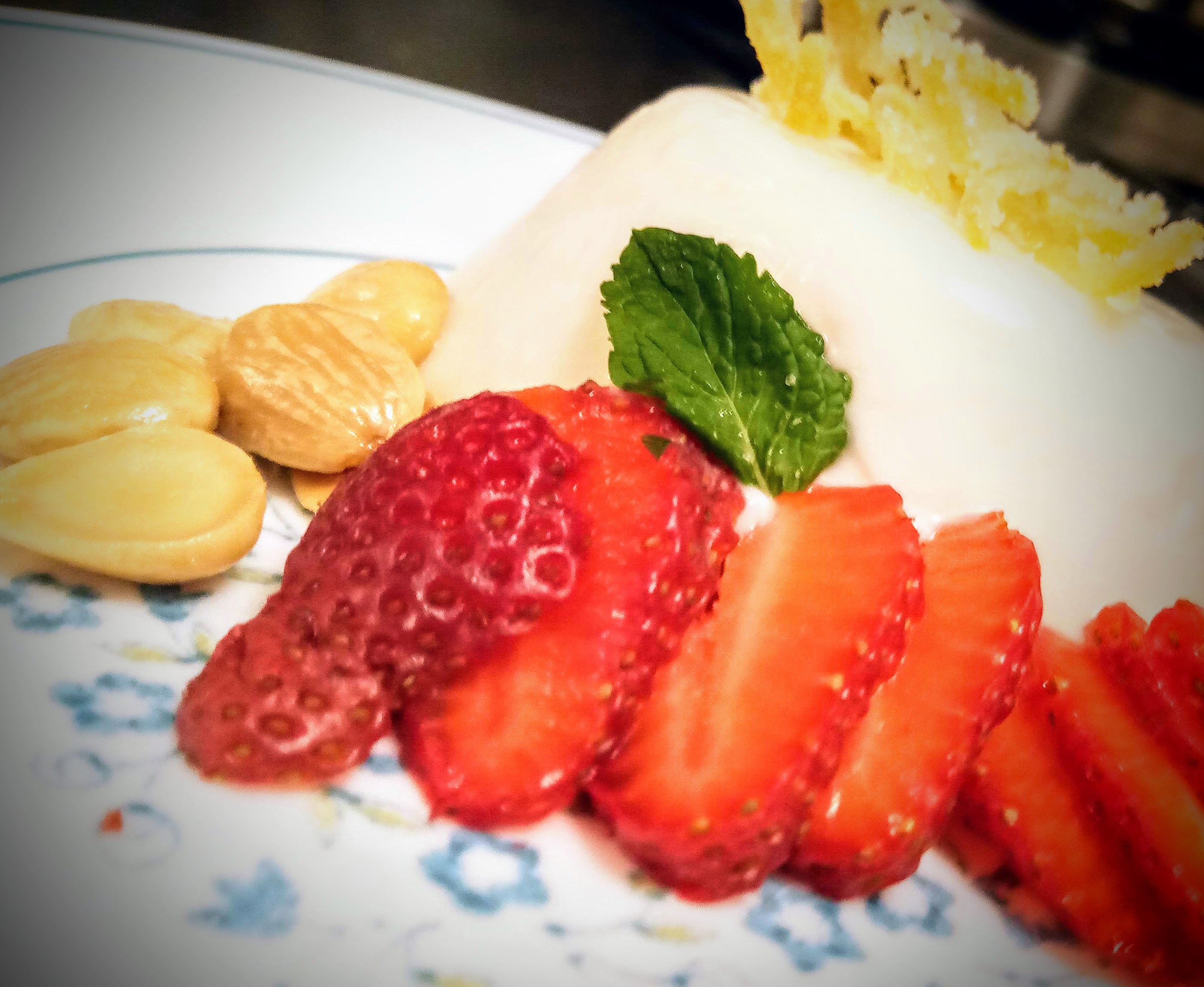
 If you don’t have time to make a whole pie, a vanilla panna cotta with fresh, sliced strawberries, almonds and some simply candied lemon zest makes for a simple, and light dessert. They’re lovely as a crème brûlée. Growing up, a favorite of dessert of mine was strawberry short cake. I have come to create a modern and elegant plating of the American classic. Compressed strawberries are brunoised and piled to form a “digital” looking strawberry, with sliced, made from scratch (no bis-quick!), short cake served on a strawberry coulis and served with a quenelle of amaretto Chantilly cream. I also like a little balsamic reduction on this. It seems crazy, and everyone thinks it’s chocolate sauce. When they taste it the balsamic ties it all together in a very surprising way.

Often, people associate the brassica family with autumn, and while this is accurate, many of them are bi-seasonal. Things like broccoli, cauliflower, bok choy and other cabbages, and kale all do well in the cool temperatures of spring, before the heat of summer shuts the plants down. I love the use of preserved lemon in the spring. Brassicae are highlighted by lemon, and the salty-acidic flavor helps to balance the natural bitterness of them.

Radishes and Turnips are both quick to grow and enjoy the cooler climes of spring. Their sweet and peppery bite are great for more than just salads. At the restaurant this past weekend, we served a spring bruschetta: grilled bread spread with a beautiful, bright green scallion puree, thin-sliced Spanish dry chorizo, roasted local turnips, and pecorino then drizzled in olive oil before serving.

You don’t need liver and chianti to enjoy fava beans, but they are difficult to find fresh in stores, so your best bet is to find them at a local farm. They are laboriously tedious to process, but the reward is well worth it. Check the book Ottolenghi for a delightful recipe with them. They can stretch over many flavor profiles and are well suited toward East Asian flavors, as well as Mediterranean, Moroccan, and more!

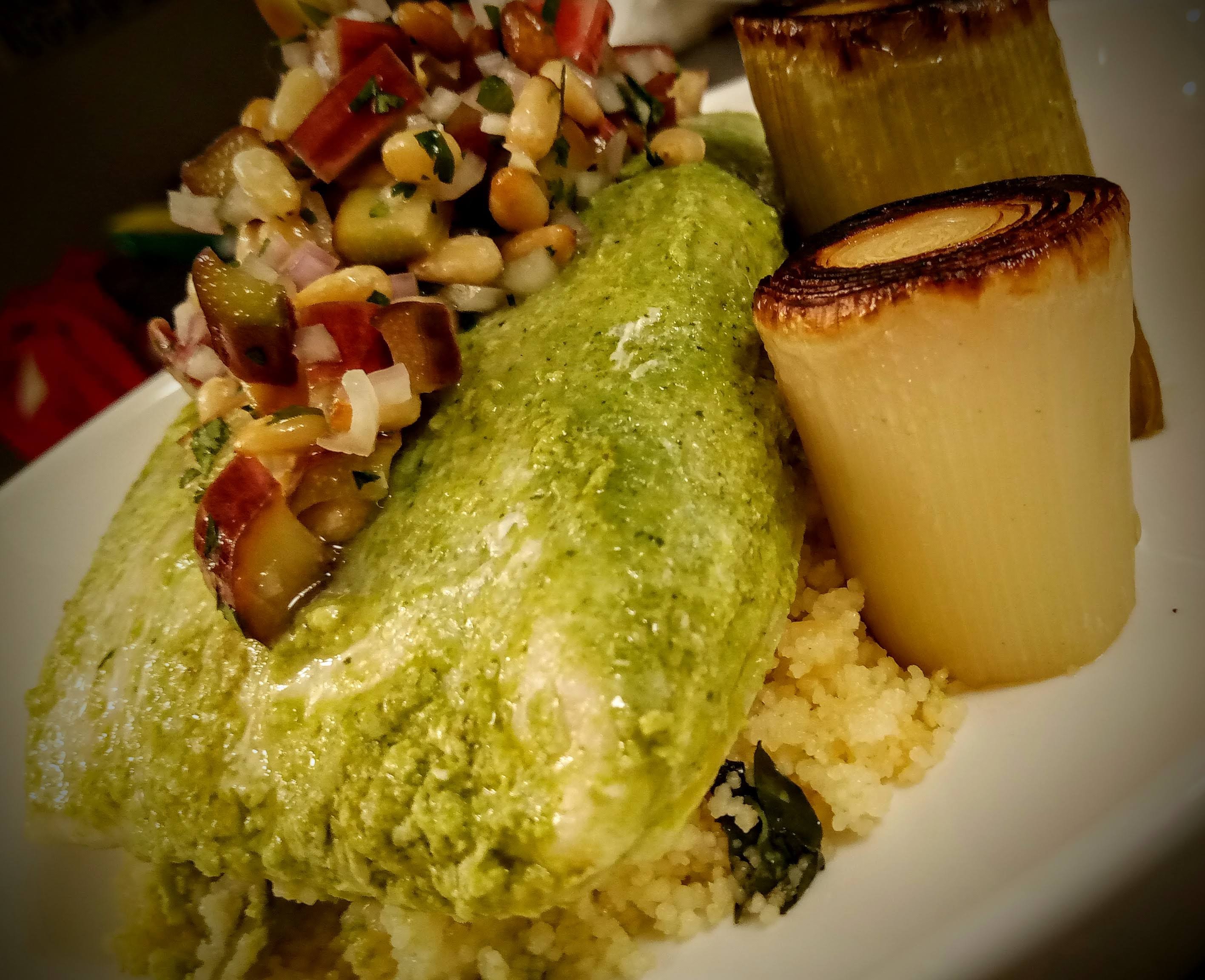
Undoubtedly, the king of spring is the highest prized flat fish: Halibut. When treated properly it is flaky and wonderful, when treated improperly it is dry and insipid. I prefer either poaching or sous vide for cooking halibut as the lower temperatures keep the fish flaky and moist. Pan searing and finishing in the oven is also great, but great care must be taken not to overcook it. Pictured below is Halibut sous vide in watercress pistou, Couscous with fava beans, preserved lemon and basil, braised leeks, and a macerated rhubarb and pine nut relish.

There is nothing quite like the warm welcome of spring. Our appetites lighten, and our cravings head toward lighter flavors. It seems so often that asparagus and artichokes overshadow so many other beautiful Spring ingredients, like turnips, nettles, lovage. It is a miraculous gift of nature that everything in the season grows in a way where it compliments everything else in that season. Spring has indeed sprung!

Autumnal Aromas

Like any basic white girl, Autumn is my favorite season. The holidays, the outfits, the colors painted on the trees, the perfect weather, and most importantly the food all stand superior to the other seasons. Apart from the food festival of Thanksgiving, which we will discuss at length when we’re closer to that time, the fruits and vegetables of the season, as well as the heartier style of cooking cause a nostalgia of simpler times.

As soon as the weather starts cooling, I love keeping large batches of soup on hand. This also helps with the quick meal planning that we discussed last week. There are possibly inifinte types of soup to choose from, and nearly every culture utilizes them, making it easy to change flavor profiles. Add a grilled cheese or other sandwich and repeat with endless combinations.

The same principle applies with stews, which crock pots are fantastic for. The starches can be varied as much as the stews. Pumpkin, sweet potatoes or squashes can be pureed and give you a nice sweetness to compliment the hearty, savory stew. Egg noodles, Spaetzle, and couscous also make wonderful bases for stews as well as rice or other grains. Polenta whether soft or firm, is ideal as a stew base.

Passion for pasta picks up for Autumn as well, and as with soups and stews, it is very easy to pre-prep various sauces and ingredients. From Alfredo to Ziti, pasta possibilities are endless. A homemade pumpkin ravioli with a wild mushroom ragout screams “Autumn” all over.

It just isn’t Autumn without apple cider (and doughnuts!). I drink and cook with it the entire season. It’s uses in cooking are numerous and all delicious. It can be reduced and turned into a syrup which goes wonderfully on desserts. Using it in soups is common, particularly a pumpkin, butternut squash or parsnip soup. It’s lovely in as the liquid for a relish, think caramelized apple and walnut/pecan relish atop some pork or fish. It also lends itself well to salad dressings, brines, and marinades. It mixes beautifully for adult beverages, and indeed some of my favorite cocktails contain it.

There’s something wonderful about the combination of Brussels sprouts and butternut squash beyond the sweet squash to counteract the bitter Brussels. There’s something spiritually Autumnal about the pair. Pre roasting some diced squash and halved or quartered Brussels and then to saute them in the fat of bacon or guanciale, perhaps a splash of vinegar (Champagne comes to mind), then seasoned and mounted with butter is a favorite side dish of mine in Autumn. Perhaps use the squash as a starch like a puree or gratin, with a side of fried Brussels. If one were to take a butternut squash puree and reduce it to paste, it can be added to gnocchi or pasta dough for color and a light sweet flavor. Perhaps tossed in a Brussels sprout pesto sauce, but be sure to add a little honey and plenty of salt to the Brussels.

Wild mushrooms abound in Autumn and their wonderful earthy flavor goes with everything, and on their own. All manner of mushrooms can be found in the right places, and there are so many kinds: Criminis, portabellos, and white buttons are fine but, hedgehogs, chantrelles, black trumpets, king trumpets, shiitakes, maitakes or hen of the woods, not to be confused with chicken of the woods, oysters, enoki, morels the list goes on and on!

The fruits of Autumn are all lovely as well. Apples and their infinite uses vary from sweet to tart. Pears glazed or soaked in red wine and topped with blue cheese, particularly gorgonzola makes for a lovely Autumn dessert. Cranberries are wonderful when candied, or made into relish. Persimmons are great for salads or sauces. Fresh figs are delightful, but they have many uses as well. They make for excellent jams. When halved they take to a quick kiss on the grill in a lovely way, then fill with chevre or blue cheese and wrap it in a little prosciutto and you have a wonderful appetizer or hors d’oeuvres.

Root vegetables begin coming into season in Autumn. Parsnips, rainbow carrots, turnips, radishes and sweet potatoes all come into season, and their many colors and flavors are delightful as well. A favorite side I’ve made for a dinner party was vanilla roasted parsnips which were incredible. The peppery bite of turnips and radishes compliment well the hearty Autumn flavors. Rainbow carrots are not only beautiful on a plate they’re delicious too. I like to sous vide them (keeping their colors separate so they don’t bleed out) with a bit of butter, some cloves and star anise. Then when you want them, just saute them up in a little of their own butter for a great side dish.

Autumn is upon us, and with it all of its wonderful aromas. With the changing of the leaves, the beautiful weather, and the incredible food, Autumn holds its own as a great season. The many flavors all compliment each other in a beautiful way, and the aromas when cooking bring a certain wistful feeling to our hearts, and the hearty dishes satisfy our souls.

“But I Don’t Feel Like Cooking!”

So often for people who work in restaurants, and I imagine with people in other industries as well, we just don’t feel like cooking after work. This frequently results in eating less than quality food that is done quickly and with little to no effort. Or going to another restaurant to get food, which of course costs money. So how do you get nutritious meals that don’t break the bank, and just as importantly how do you get it so that you don’t have to put in much effort, and cook your dinner quickly?

The answer lies in proper planning and prep work. For those of us who work in restaurants we often receive a shift meal, so taking a look at my week I don’t count any dinners for evening shifts or breakfast or lunch during day shifts. Once I know how many of what meals I need, I determine a few main dishes I’ll want to eat throughout the week or two, and then maybe a couple snack foods to enjoy whenever. When it comes to dinner I try to use recipes that will utilize the same ingredients for multiple purposes. This still allows for eating all different types of cuisines and recipes!

Chickpeas are a versatile way of making multiple entrees and your snacks for the week. They’re also pretty inexpensive. Two pounds of dried garbanzos will stretch farther than you would think. One pound can be used to make falafel mix which will freeze well so you needn’t use it all quickly. For the other pound you can cook it all off and use half for hummus and the other half to make chickpea burgers, or a curry dish, they’re great on salad or lettuce wraps.

A very simple way to go about this process is tacos. I think for most people it’s difficult to get sick of tacos. And there are possibly infinite types and toppings. So if you cook off a large batch of some tasty carnitas, you have something you can heat up quickly.

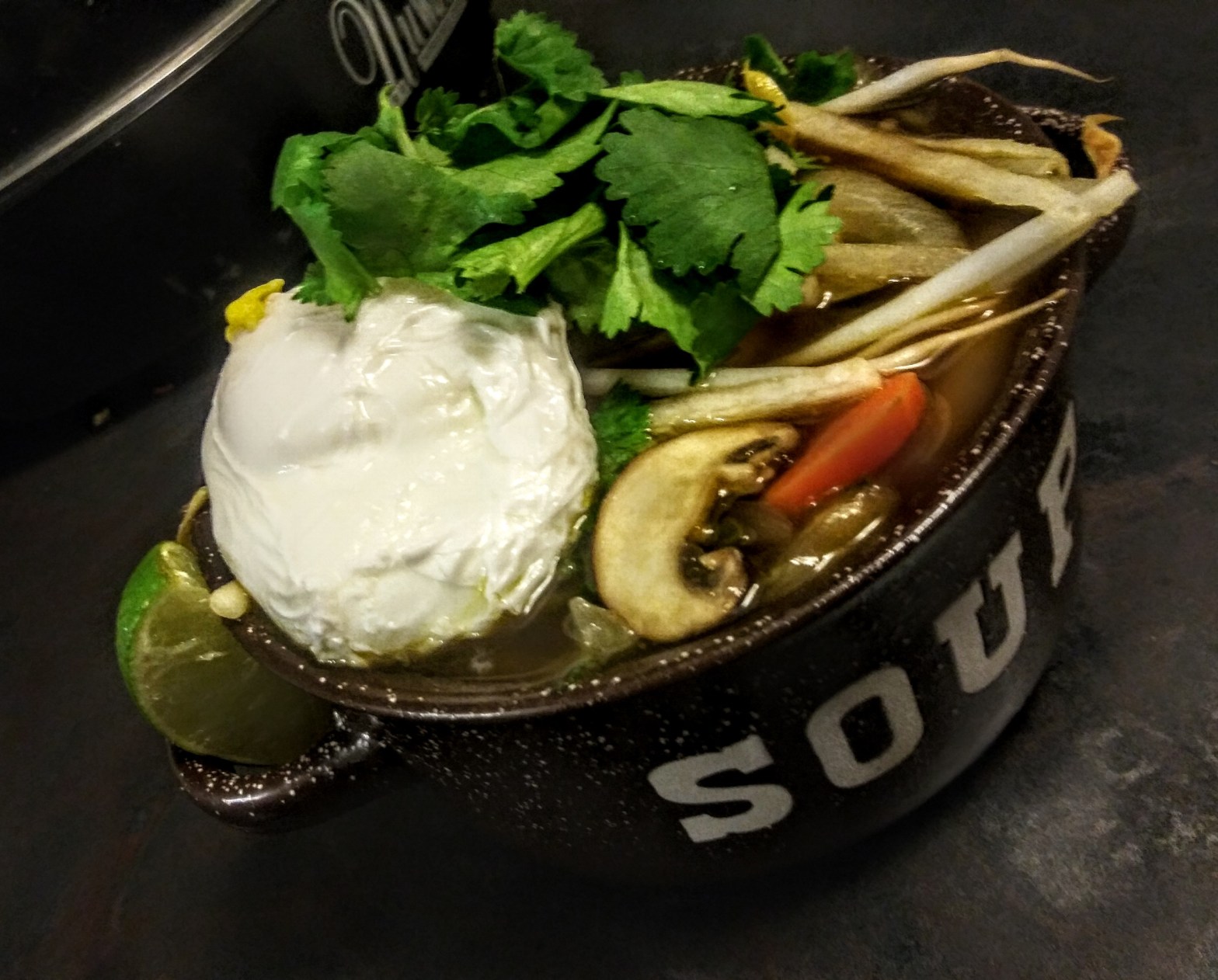
I encourage people that when they buy chicken to purchase whole chickens and fabricate them into smaller cuts on your own. This way, you get two breasts, two leg and thigh combos, two tenders, four wings and a carcass for stock. I love stock making, it’s so simple, useful and it makes a home smell wonderful. I usually freeze half of it, including the stock, except that I freeze the wings and tenders together for a fried chicken dinner. The rest of it is dealer’s choice as the choices for chicken are endless. Most recently I used the stock along with some extra vegetables and aromatics to simmer the first leg and thigh in a ginger broth that I added soy sauce to after the chicken was done. Now with loads of pre-cut onions, carrots, bok choy, mushrooms, celery, and just a few slices of serrano chiles for a little kick, a pre-made broth, chunks of meaty chicken, par-cooked udon noodles, to be finished to order, then topped with julienne daikon radish, mung bean sprouts, and a poached egg, I can have a chicken udon bowl made in just a few minutes. For the first breast I’ll likely use it for something simple, like a chicken caesar salad. For the frozen stuff (the fried chicken package notwithstanding) I don’t have specific plans yet, but perhaps I’ll braise the leg and thigh to make B’stilla, a Morrocan sweet and savory delight wrapped in phyllo dough and topped with ground nuts and spices. Then maybe the breast can be used for a pasta dish, either utilizing some of the stock or making an entirely different sauce.

It doesn’t stop with chickpeas and chicken! I’ve long desired to get a nice eye of round and use it for delicious philly cheese steak sandwiches and chicago style Italian beef sandwiches. Or even homemade gyros that can be heated up quickly. Meatballs can be made ahead of time and then you have a choice of sauce, maybe one night you have Swedish style and the next night barbecue, and still the next night put some of the giardenera from your italian beef onto a classic meatball, marinara, and mozzarella sub.

With some pre-planning and a fair bit of prep work (ideally concentrated on one day) it isn’t difficult to find delicious dishes that can be finished to order in a few short minutes. It saves money, and although there’s a lot of prep work involved it makes it a lot easier on those days when you just don’t feel like cooking. Plan and prep it all out ahead of time and you’ll thank yourself later. And although some of the options I have mentioned are not exactly healthy, they are at least wholesome if made from scratch. A home cooked meal always sits better in my stomach than a processed frozen one. Follow your own food, and it just might lead you to something great.

The Misconception of Vegetarian Cuisine

So often, upon hearing a dish is vegetarian, many meat eaters will turn their nose up to it. Americans have been conditioned, it seems, to believe that vegetarian food is bland and boring. While I, myself am not vegetarian, some of my favorite things to eat are. The meat and potatoes mentality is surpringsly limiting to the palate.

One of my favorite dishes is falafel. Little garbanzo bean fritters loaded with herbs, spices, and flavor are shaped then fried to perfection so that a crispy, thin crust gives way to a light, and fluffy morsel. Often served with it is Tahini sauce, an umami delight made from watering down Tahini, adding lemon juice for a nice tang and hit with some smoked paprika, and just a dash of cayenne to open the palate. Or still in the Mediterranean realm, Spanokopita. Spinach and feta wrapped up in buttery, flaky phyllo dough and baked to a crispy golden brown, then served with Tzatziki: a cucumber yogurt sauce with hints of floral oregano and mint.

Another of my favorite dishes, and actually what I made as the entree for my exit exam from culinary school is a simple eggplant parmesan. Fried food is always delicious, and eggplant is no exception. A good eggplant parmesan requires a robust marinara, and topped with fresh melty mozzarella and either Parmigiano Reggiano, or at least a high quality Parmesan. It just isn’t summer without lovely, juicy, ripe heirloom tomatoes. A simple Caprese salad made with those wonderful tomatoes, fresh buffalo mozzarella, and fragrant basil leaf all drizzled with a little olive oil and topped with flaked salt of some speciality or another is a wonderful way to celebrate vegetarian cuisine.

Sushi is one of my favorite things to eat, and it is certainly more than fish. In fact, the word “Sushi” actually translates to rice. Sushi is much about celebrating food in its natural state. Something as simple as some raw asparagus cut in such a way to fit as a piece of nigiri, tied to the rice with a small strip of nori couldn’t be more delicious, and the choices go on! Mushrooms, radishes, carrots, cucumbers and many more are often found adorning the many styles of sushi.

Vegetarian soups are often wonderful and indeed Minestrone is one of my favorites. A rich vegetable broth with tomato paste loaded with whatever vegetables are around, and egg noodles warms up your body and soul. Pho can be made vegetarian as well, and while the idea is the same as minestrone, the flavor profile and noodle type are very different.

Tacos, Tamales, Pupusas and many other Central and South American treats can certainly be made vegetarian. Nearly every time I go for Mexican food, I order at least one jalapeño and cheese Tamale. One dish from Mexico which I dearly love is Chile Relleno. A fire roasted poblano pepper is taken and stuffed full Queso Oaxaca, a mild, melty, gooey delight, then battered in a light egg batter and fried. Pour some salsa roja on top and enjoy.

Another summer delight that really showcases the natural beauty of vegetables is Ratatouille. Traditionally made from eggplant, zucchini, summer squash, every color of bell pepper you can find, tomato, and onion, however many varieties exist as the word translates to stew. Winter varieties made from turnips, beets, rutabega, parsnips and carrots are hearty and delicious.

Vegetarian cuisine is not only wonderfully delicious, but often good for you. It isn’t difficult to make a dish look beautiful because with the many colors of vegetables, nature does the work for you. Nearly every culture in the world has vegetarian options, which offers many flavor profiles to utilize. The misconception that just because it’s vegetarian it must be bland and unappealing is plainly not true. Flavor is packed into the things that grow from the Earth, and they deserve the respect of appreciation as much as any meat.

Boulder At a Glance

Welcome back to Just Follow Food! What a crazy week it was moving, and I definitely needed the time off to properly handle everything. That said, it’s great to be back and I hope you’re glad to be back too! Colorado is gorgeous and the sun shines over everything (at least most of the time!), with only a few clouds to decorate the azure sky and offer the occaisional shade. There is so much here to explore and so much food to follow. Situated Northwest of Denver, Boulder rests against the beautiful Flatiron Mountains; beautiful rock formations that jut out of the mountainside. One nearly expects a huge stone dinosaur or Pokemon to rise out of the mountain.

Immediately upon exiting my new home, I get the best view of those beautiful peaks and I think of what it was like to be atop the summit of the first one, and what a view that offered. Naturally, after moving I needed to some necessities and found a Target within walking distance. With a short walk down 28th Street it looks as if I could eat at a different place every day for six weeks and not repeat a single one. In addition, there are several ethnic markets, all of different origin. My work is certainly cut out for me and I am thrilled to follow food in auch a diverse area. Mind you, this is not even including the lovely Pearl Street Mall which also abounds with food and drink.

One of the first places that caught my eye is Dot’s Diner. I love having a good breakfast place nearby. There’s a Thai and a Vietnamese restaurant both basically across the street from my house, and another of each just down the street. Boulder Pho is just a quick walk, I know I’ll be frequenting there as the weather cools. The Asian market was the first one I came across, so I know I’ll be exploring that. There’s 3 Margarita’s Family Mexican restaurant across the street, and although I haven’t found it, Google maps informed me of a Mexican market is also close. Ali Baba Lebanese and Mediterranean Grill is certainly not too far for me to get my falafel on, and indeed the Mediterranean market was the second to catch my eye. A place I know my sister will be excited to visit when she’s able to make the trip out.

There were at least three Indian places on the turnpike, as well as the third market: an Indian one. A restaurant called Tangerine sits in a nearby plaza, a name which certainly piques my interest. D’Angelo’s Italian Deli is right nearby. Although it’s not directly on the turnpike, Salvaggio’s Italian Deli and market sits just off of it on Pearl. There’s a cute bagel shop a short walk away.

Flying, while usually fun as long as nothing goes wrong, is still exhausting and hunger-inducing. Bridgette, a dear friend of mine mentioned in previous posts, was kind enough to deliver me to the airport and bring me my favorite muffin: chocolate chip. After eating fairly little, and spending all day in airports, planes and cars I was famished. Alicia, another dear friend of mine who has attended at least one dinner party and a Thanksgiving dinner, picked me up from the airport, and took me to my new home. Once we got all the luggage and my cat Minerva inside, Alicia and I both needed food. We found a place called T/aco and decided it was the best option. They had happy hour street tacos for a good price, so I got four of them. Two chicken tacos with red salsa, and two carnitas with a pureed pineapple and I believe habanero salsa. Naturally I had to have a beer after getting off a plane, and with their happy hour special on drafts I got an Avery IPA made right here in Boulder by a brewery of the same name. While you can find my beloved Two Hearted IPA at liquor stores, I’ve yet to find it on draft. While there’s no substitute for my go to beer, this balanced IPA drinks in a very similar way.

Alicia had three tacos all of different varieties, but they all looked very tasty: one vegetarian one with mushrooms, onion, and rainbow chard topped with grilled Cotija cheese, one with pork belly, guajillo salsa, fresh Cotija, and cilantro, and the last with mango marinated chicken, oaxaca and cheddar cheese with a mango Caesar dressing. The grilled Cotija atop the mushrooms looked absolutely spectacular.

I am so excited to explore the wide variety of restaurants and breweries. While it will likely be a while before I am able to eat at many of these places, I look forward to following all the great food to be had here. Whether I’m cooking at home, or eating out there’s certainly a seemingly endless variety of restaurants, and specialty markets. I feel arguably more excited about the markets than the restaurants. With so much at my finger tips, I can try a ton of new recipes at home.

I’m glad to be posting again, and I’m glad you’re all back too! I’d like to thank you all for your patience as the move was very hectic. While it may be a while for a restaurant review, we’ll still be following food weekly, now that Mini kitty and I are all settled in the mountains.

Dinner Party Delights: Part II

As I’ve continued to hone my craft, each successive dinner party has gotten better and better. The three most recent ones have really been shining stars. Composed mostly from ordering whole chicken and whole duck, I had tested a menu of my own making and last week we covered the dishes made from the birds. This week, in continuing our discussion about the Bistro’s menu, we’ll cover the dishes made from the other animals the menu utilizes. In addition we’ll talk about another dinner party celebrating the bringing together of two sisters, where I retested some recipes that I hadn’t felt spectacular about before.

                The party following the chicken took place in the early fall, somewhere in October if my memory serves. The leaves were all changing, but the weather was still sunny and warm; although the days were noticeably shorter. On a cool autumn evening, my guests arrived with the smell of fresh baked bread filling the house. I always serve homemade bread and a lemon and herb butter at the beginning of each service. After munching on that for a bit, we started with a homemade charcuterie and artisan cheese board. About a month before the party I had cured short ribs and hung them in my fridge wrapped in cheesecloth. This is in no way a traditional charcuterie item, but the notion sounded really good to me and indeed it turned out wonderfully. The thin shaved short rib had a peppery steak flavor, and the fattiness of the short rib really lent itself well the curing of this product. Also featured on the board was homemade pork rillettes. If you are unfamiliar, rillettes is traditionally pork butt cooked in its own fat at a low temperature for a very long time. The meat is then shredded finely, and mixed with enough of the fat so that it is spreadable at room temperature. It is capped with more lard, like many pâtés, in order to help preserve it. The rillettes were a huge hit at the table that night. There is no way to know what cheeses were selected for that night, but if you’re making homemade charcuterie, you’re getting a good cheese to grace the board as well.

                To cleanse the palate after our appetizer that night we had a Belgian endive salad. The leaves were kept whole and used as a boat for the other salad components. It was kept simple with bacon lardons, candied walnuts, garlic herb Boursin cheese and a homemade white wine vinaigrette drizzled atop the three boats. To my surprise, the table was raving about this salad. Not that I also didn’t find it tasty, but it’s not often to hear such compliments about a salad.

                Much like the chicken recipe testing party, we had two entrees that night. There was two of each, so the four of us each essentially ate one entrée portion. The first entrée we had that night was a beautiful beef tenderloin, seared to a ruby red rare, and served with sauce bordelaise, which is a red wine, and beef stock reduction sauce served with a garnish of roasted bone marrow, it can be cut into coins, small diced or even cold oil dripped to make pearls. For the sides with the steak I made a butternut squash gratin with thyme, and gruyere cheese. At the time I didn’t have a mandolin to slice the squash nice and thin, so it didn’t hold together quite as well as I would have liked; although it tasted lovely. For the vegetable side we had roasted Brussels sprouts sautéed with bacon lardons and hit with just a little red wine vinegar, then mounted with butter. They were very tasty.

                For our second entrée that evening, I served my take on Bœuf Bourguignon. Bone in short ribs, braised in red wine garnished with the lardons, carrots, and pearl onions. This sat atop a bed of homemade egg noodles tossed in the same herb butter I served at the beginning of our dinner. The egg noodles came out beautifully and in addition to their buttery delight, they caught the rich sauce from the short ribs as well. As our vegetable side for the entrée I cut obliques of parsnips and roasted them in the oven, until just achieving a little golden brown. They were then sautéed in butter and the pulp from a vanilla bean. They were wonderful and it was definitely a highlight of the evening.

                We had a savory dessert that evening in the form of a cheese soufflé. It was alright, but needed more cheese. It had achieved a nice rise however.

                The following party took place in mid spring. The rains of April were finally settling, and we were inching closer to May. Instead of the red wines that guests brought to the beef testing party, they brought whites to pair with the seafood we were eating that night. We started with a Roulade de Poisson, or stuffed fish roll. I was unable to find the sole fish that I wanted to use for this recipe and had settled on trout instead, which worked okay, but I believe this dish needs to be retested with the proper  fish intended for it. I made a mushroom duxelle and each filet was rolled with a little of this as a filling. The fish was then baked to flaky perfection with a small pad of lemon herb butter on top. It was served with a ramp leaf pistou and braised Belgian endive, then garnished with candied lemon peel.  Ramps, if you don’t know are a wild onion, with red intensely oniony stalk, and flat green leaves that have a delightful garlicky flavor. The table loved this dish as well, although we all agreed the portion size was large for an appetizer

                Our salad that evening was made from some lovely local spinach tossed in a homemade red wine vinaigrette, gold beets, toasted cashews, pickled ramps, and goat cheese. The salad was nice, and everyone enjoyed it. The spinach should have been torn though, and again the portion was a bit big for a salad.

                For our entrée that evening, I served a wonderful medium rare salmon filet with an herb hollandaise. It was served atop a bed of French Puy lentils stewed with pearl onions and bacon lardons. As something of an afterthought, I took the greens from the gold beets and what was left of the spinach and braised them as a vegetable side. They turned out nice, and I was glad to utilize some things I hadn’t initially planned on. I garnished the salmon with a single leaf of fried parsley. The lentils paired really nicely with the fish, keeping the dish nice and light.

                Our dessert that evening was a lavender crème Brulee.  The small torch I had bought wasn’t great at melting the sugar, but the oven’s broiler served that purpose just fine, and the crunchy caramel crust was a lovely golden brown. The sweet and floral custard was nice and rich, and the lavender was kept light so as not to give it a soapy flavor.

                Last year around Christmas I got probably the coolest gift ever. I have a sister that had lost touch with the family almost two decades ago. When I lived in California I had resolved to try and find her, but had only two small details to go on, and the odds seemed against me. I searched on Facebook as well to no avail. But this past Christmas, Kerri found me! In March she came and visited, and we got to spend some time together.

                Naturally in order to properly celebrate, we had to have a dinner party. I had received some pretty cool things from a tragic accident that occurred at the restaurant I work at.

                For our meat and cheese board we had smoked ham hock rillettes, and smoked salmon mousse, along with some nice cheeses, and the accompaniments for each item. These always go fast and are big hits with the table.

                For our salad that evening, I got a wide variety of citrus including grapefruit, blood orange, caracara orange, and a little navel orange which my lovely friend Bridgette was kind enough to supreme, or cut just the fruit wedge out with no pith. She has been to the last five dinner parties, and I will really miss seeing her so frequently.  This lovely collection of citrus was tossed with a small amount of arugula, a little thinly shaved fennel and goat cheese. Instead of a dressing, I just used a bit of the mixed citrus juice, a light drizzle of a honey ginger vinegar that Kerri and I  found at a cute little shop in South Haven on our little adventure out there, and just a little olive oil. It was then topped with coarse sea salt.

                For our entree I retested my take on Canard l’Orange, and served a medium rare duck breast with an orange gastrique and garnished with pickled orange rind. For our sides, I retested the butternut squash gratin this time with a mandolin in my possession to get the nice thin cuts I wanted from the squash. It came out much better and indeed was a highlight of the meal. For our vegetable side, we had a roasted mushroom medley, sautéed with guanciale, and some herbs. The whole table was raving about the mushrooms. The only real issue with the dish, which I didn’t notice until seeing a picture of it, was that it was a little monochromatic.

                I retested the cheese soufflé for dessert, and while it turned out better, I ultimately have decided to rework the dessert menu a bit and will be changing it to a chocolate and amaretto soufflé. I certainly have some retesting to do still, but otherwise only one dinner party remains. It’s very possible for that to be next month some time; as yet another housewarming seems likely.

                As a side note to my readers, with my big move to Colorado being next week, I will unfortunately not be making a post next week. Not to worry though, we’ll continue to follow food the first week of September.

Dinner Party Delights: Part I

One of the things I have absolutely loved doing as part of my journey of food is holding dinner parties for friends, and family. The initial idea came to me after a party that was held for my brother many years ago and I prepared a traditional Italian five course meal. We started with marinated olives, pesto and bread. Olives were a strange choice for me because I only began liking olives a couple of years ago. I made some simple pasta or another for the Primo, and the years have caused me to long forget what it was. The Secondi was a large roasted pork loin that I served with roasted redskin potatoes and some vegetable that I can’t recall. For dessert I made an olive oil cake with cherry compote. The food turned out well, and my passion for food was really coming alive. It was only a few short months after that that I began culinary school.

                 Once I was in culinary school, I was surrounded by a huge, like minded group of fellow students.  Most of our group of friends’ nights not spent at jobs or school were spent cooking dinners together. Sometimes we would each make a dish and we’d eat family style. Other times one student, perhaps with a “sous” would spearhead a whole dinner. There were so many of these, and it was so long ago now, that I truthfully cannot recall all the details. The shared passion between all the students was so enjoyable, and many of us spent most of our free time just talking about food, or exploring the many restaurants of Pasadena. Incidentally, one of my current coworkers and I lived there at the same time, although we didn’t know each other then. More interestingly perhaps is that we both frequented a restaurant called Haven Gastro Pub, which is sadly closed now, but was run by another recently former coworker, who neither of us knew at the time. It really is a small world.

                When I moved back to Michigan, and got my first place on my own I held a housewarming party. I had a few friends over, and served braised short ribs for the entrée, with horseradish mashed potatoes. It was good, but it was then that I had the idea to start working on a business plan for a small Bistro. The first step in this process was menu planning. I developed a menu of French cuisine bringing some classics into the modern. Now the plan became to use dinner parties to test the recipes of the menu, and after a few years of doing this, I have just one more dinner party before the entire menu has been tested.

                The menu is primarily built around purchasing whole chicken and whole duck, and I decided the first round of testing recipes should be the duck recipes. This meant starting with French Onion soup, as one of the things I did for this was to use half duck stock instead of only beef stock. It adds a wonderful smokiness to the soup. Then I fried homemade sourdough in duck fat, topped it on each individual bowl of soup loaded with caramelized onions and rich broth. Then each bowl got a nice, thick slice of gruyere cheese before being put under my small at home oven broiler. Under a normal restaurant salamander this would happen much faster, but most equipment designed for homes just isn’t quite as hot as industrial kitchen equipment.

                For our second course that night, I made a duck confit terrine, which turned out very nice. Duck leg and thigh slow cooked in duck fat until it’s fall apart tender, then shredded, cooled, and held together with homemade duck demi-glace. I’m sure we had a cheese along side the terrine, but the identity of it has long since been lost to time.

                Our entrees that evening were pan seared duck breasts served with an orange gastrique, peas with bacon lardons and pearl onions, and a simple potato preparation. This party was many years ago now, and looking back I recognize some inexperience on my part. While the food turned out tasty, there were certainly things I could’ve improved upon. The peas were slightly undercooked, and the duck slightly overcooked. As I’ve grown in professional experience each successive dinner party has gotten better.

                The second round of recipe testing seemed leaps and bounds ahead of the first one. After all the duck recipes I decided that preparing the chicken recipes would knock out about half of the menu. The chicken came from the wonderful Carlson Farms in Lawton, Michigan. It was spring when my friends came to my new apartment, all dressed so nice, and bringing bottles of wine to share with the table.  We started that night with Poulet Roulade, or a stuffed chicken roll. I took one of the breasts and pounded it flat with my meat tenderizer, then laid it flat across bacon that I had lined up to wrap the entire appetizer. For the filling I lined roasted red pepper, fresh asparagus, an artichoke duxelle that I had prepared, and some grated gruyere cheese. After rolling and trussing the roulade, it was seared in a pan until the bacon was crispy all the way around, and then finished in the oven. I served it with a pan reduction sauce, and glazed radishes. The whole table was really raving about it, and I believe it came to be the highlight of this particular party.

                I made a simple salad to cleanse the palate before the three separate entrees that night. The salad was comprised of arugula, tossed in homemade balsamic vinaigrette, shaved fennel, marcona almonds, goat cheese, and in keeping with season, fresh local strawberries.

                The entrees consisted of the remaining cuts of the chicken, only one dish of each, to be shared amongst everyone. The airline breast was pan seared, oven finished and served with a pan reduction sauce and gratineed camembert. Here I retested the Pommes Parisienne the simple potato preparation I mentioned earlier. It’s melon balled scoops of potato, blanched then sautéed with butter and herbs. We had some sautéed asparagus as our vegetable side with the Poulet Sauté. Next we had a Blanquette of chicken made from one of the leg and thighs. This is a braised dish done in white wine and chicken stock.  So when making the sauce, I reduced the braising liquid and then thickened it with a beurre manie and a liaison made of heavy cream and egg yolk, it’s then finished with just a dash of lemon juice to brighten the flavor. The leg and thighs were fall apart tender and the rich sauce was wonderful. The last entrée we tested and tasted that night was the French classic Coq au Vin. The other leg and thigh braised in red wine and chicken stock then served with its own braising liquid turned to a sauce, again reduced and thickened with beurre manie. Garnishing the lovely leg and thigh combo was plenty of bacon lardons, quartered mushrooms, and pearl onions, and this classic stood out. The meat was also fall apart tender and seasoned perfectly from its time in brine. For simplicity, cost and the overall crazy amount of food for four people to eat, both stews were served with a simple, but tasty pommes puree, and a retesting of the peas with lardons, and pearl onions.

                For dessert that evening, everyone had a beautiful quenelle of homemade chocolate amaretto mousse garnished with homemade marcona almond brittle; which was just the right thing after eating so much food.

                Since that dinner party there have been three more, two that tested the remaining meat items and one that retested some recipes that I didn’t feel great about the first time I did them, but I don’t want to overload your appetite, so perhaps next week’s post will be a part two to this one explaining the three most recent dinner parties. Each time I’ve done one of these I’ve learned a great deal, and always find new areas to improve, and naturally everyone who comes to one has a wonderful time.

Following Food: Principle Food & Drink

Although I’m leaving it, Kalamazoo is not without its charm. The lovely, little Kalamazoo Mall is such a nice place to be on a sunny, summer day. If you’re a people watcher like me, the mall is crowded with folks walking around to shop, going to dinner, or a show, or maybe going rock climbing, or sitting on patios enjoying an afternoon adult beverage in the warmth of the sun. As one meanders down the west sidewalk of the mall you come across an impossible to miss giant capital “P” in an old timey font, emblazoned in light upon the sidewalk and it is then you know you’ve arrived at Principle.

                 Walking into a dining room that brings together a classic era and the modern one, you’re welcomed by the host stand. A pleasantly small bar sits on the left, and a long comfortable bench seat that runs the entire length of the wall sits on the right, with tables cohesively interspersed between. The dining room is just large enough to feel that “I’m out to dinner feeling” but not so huge and loud that you can’t hear your fellow diners.

                Principle hits their 4 year anniversary this month, so if you haven’t been yet, you’re making a dire mistake.  Whether you’re going in for some of their delicious classic cocktails and tasty shareable snacks, or heading in for a full dinner; the fantastic food, delightful drinks, and lively ambiance is always a wonderful experience.

                 Their beer and wine lists are perfectly satisfactory with choices for everyone to enjoy, but the real gem of their drink menu is their cocktail list. It has a wide variety of craft cocktails, both classic and modern, or twists on the former. For example the Pilar Old Fashioned; a twist on an old fashioned using Papa’s Pilar 24 dark rum, black walnut and Peychaud bitters, and demerara sugar. I always love a good old fashioned, and this one made with rum is absolutely spectacular. The black walnut is fragrant and I cannot stress enough how wonderfully smooth this drink was. The Traveler is another standout made from Journeyman gin, St. Germain, agave, lemon, and Aperol which makes for a nice tangy beverage. Much like their food menu however, their drink menu is rotational; and so the other drinks I’ve had at this great little locale, are no longer on the menu, but not to worry! Their bartenders are always mixing up great cocktails, and the list has a little something for everyone.

                Principle boasts snacks and small plates galore! A few years ago, when they first opened I met with some friends at the bar, and while I was full from lunch, I felt simply compelled to order their house baked cheese crackers. Cheez-its are a guilty pleasure of mine, so to have house baked little cheese crackers just filled me with glee. One of the other ladies I was out with had ordered a house baked pretzel that was equally fantastic, although tragically these are no longer available. Another time, I was on a date there, and we started with the homemade pork cracklins (which we opted for spicy) and what could there be to dislike about them? I wished for a bag of them to bring home to snack on later, but alas, that was a dream. For my entrée on that date I had a house-made Andouille sausage served with sweet peppers stewed in hearty and robust tomato sauce. These are also sadly no longer available, though perhaps may return toward the end of summer.

                Now to stop disappointing you with food you can’t eat. I recently went with a friend and his husband as a celebration of my big move. They were telling me that the way they like to eat out with people is to start with a few snacks that everyone can share, and everyone gets their own entrée, but smaller tastes are offered or traded just so everyone can get a little taste of more of the menu. I was delighted to hear that, as that had always been the premise of how this blog was intended to be built, and how I intended to fairly and adequately review the restaurants. So to start with, we all shared the Garden Toast. A shareable portion of seasonal vegetables showing their natural beauty sits atop some beautiful seedy salt bread, all drizzled in aged balsamic and served with a buttery roasted garlic puree. We also ordered the grilled broccoli which still had a nice desirable crunch and flavorful char after its time on the grill. It was served quite simply, with spicy mayo and toasted almonds. I appreciated that they weren’t afraid to give the mayo a nice kick, as I think anything grilled pairs well with at least enough heat to open the palate.

                The portions were perfect and while I can’t speak for the guys, my appetite was whet and I was ready for my entrée. For Bradley’s dinner he had ordered the Cioppino, an Italian style fisherman’s stew loaded with smoked salmon, manila clams, rock shrimp, mussels and served with crostini. I traded part of my dish for a clam and got a little broth. The clam was cooked perfectly, and the fumet was very flavorful, although the table agreed it was just a little salty, at least when tried individually. James’ ordered the market seafood selection; in this case seasonal sockeye salmon, cooked perfectly, with a pristinely crystal clear tomato consommé with bruinoised summer squash which was absolutely divine.  For my entrée, I ordered the coffee barbecue brisket served with a potato hash, grilled tomatoes that just melted in the mouth, and a sunny side up egg on top. The brisket was fall apart tender and the coffee barbecue sauce was rich and smoky. The whole table agreed that the tomatoes were simply wonderful, and I am always pleased to break the yolk of a fried egg and watch it run all over the dish.

                We debated quite seriously on several dessert choices. James and I both appreciated having a cheese course on their dessert menu, as it’s such an underrated choice for dessert. The Billy Blue Goat cheese is served with blueberry jam, smoked almond, bread and truffled honey. However, the peanut butter banana split was the big discussion of the table served with peanut butter gelato, sea salt, banana and honey. Ultimately, we decided it was time to head to the show we were seeing at the nearby Farmer’s Alley Theatre. Bradley and James both assured me that the peanut butter banana split is incredible, and I may very well go with some friends to devour it before leaving Michigan.

                No matter when you go to Principle, they are sure to have a terrific selection of beverages, small plates, shareable snacks, and perfectly portioned entrees all sourced locally as much as possible. The craft cocktails are spectacular and their bartenders are quite skilled. The food is always seasoned and cooked to perfection; the dishes highlight the simplicity of their local ingredients, but elegant and beautiful, proving the talent of their kitchen staff and chefs. Their staff is kind, and attentive, but not interruptive and they allow the diners to eat and enjoy each other’s company in peace.  Every time I’ve had the pleasure of eating, drinking and merriment at Principle, it has been a lovely experience and indeed I would argue that it is one of the best restaurants in Kalamazoo.

Oh! This Egg is Fertilized!

When I lived in Pasadena, I had the pleasure of working in a restaurant filled with serious young chefs all from a diverse background, and all came together for a common goal. One of these great cooks was a Filipino man about my age. I had seen Balut on the show Fear Factor when it first came out, and also on Bizarre Foods on the Travel Channel. I had the rare opportunity to try one of the strangest, yet most delicious and succulent things I have ever had the good fortune of eating. Balut is an underdeveloped duck egg served in primarily the Philippines and South-East Asia. Inside this egg is the embryo of a duck. To the average American palate this sounds terrifying and at once disgusting. Nothing could be farther from the truth. This possibly controversial street food is absolutely worth eating if ever given the chance.

For his protection we will call him Gary. Gary had acquired some Balut by chance at a local Asian Market, and knowing his adventurous coworkers he brought it into work and cooked it for when we all sat down after close and ate before cleaning the kitchen.

He boiled the eggs for a while and simultaneously simmered this wonderful smelling garlic vinegar and chile sauce. Even walking by the pan this was cooking in had a wonderful aroma that could probably be applied to numerous things and match well to it. I desperately wanted to ask him why this was the sauce chosen, but I knew before trying it there would be no way to understand; so I patiently waited until we sat at the table.

“So the way Balut is eaten,” Gary explained “is by cracking open the egg from the bottom” which everyone brave enough to try this delicacy began doing. He had poured us each a small cup of the sauce. “Now pour the sauce into the egg, and drink all the juices out.” As the egg is cooked, the duck itself creates a nice flavorful broth inside the egg, so the sauce is mixed with that flavor liquid and it balances so beautifully with it.

Once the liquid is consumed you can begin peeling the rest of the egg. The yolk came first. This is entirely the yolk of a hard boiled egg. It has some veins running through it because this is how the duck is eating. Once you are through the nice large yolk comes the best part: a savory bite of wonderful ducky flavor. The meat itself is so tender and moist and the bones and beak are so soft you can bite clean through them. This may have a small crunch but it’s not unpleasant in the least. If only I had the chance to eat this again, I would be likely eat ten in a row.

There are of course animal rights activists that will say this is inhumane, but if we break it down is it? Yes the bird is cooked alive, but there are a lot of things we eat that are cooked alive. Lobster is frequently cooked alive because endorphins are released as it dies that makes the meat taste better. Mussels and many clams have to be cooked alive or the diner can become very sick. These things are not protested against. Once you get past the strangeness of the dish, you find how delicious it truly is. It has a history in the south-east Asia and is served as street food there.

During the late 1800s the Phillipines were under a lot of Chinese influence, and the practice of eating fertilized duck eggs began in the early 1900s. As filipinos emigrated to other nearby southeast Asian countires, such as Thailand and Laos, the delicacy began to spread. Now even Americans can enjoy this wonderful delicacy.